
British Government Proves Snowden correct over surveillance operations by the NSA.
"Holy CRAP -- what is our government up to?" the actor and campaigner Stephen Fry wrote on the website.
What is it with stupid governments, stopping someone who is not even in your country but only taking a connecting flight and you hold him for 9 hours !
No if you are in transit you are not really in the country which was why the US was so pissed off when Snowden hid in the Russian Airport.
Terrorist laws er? because his partner is a reporter and reported on the Snowden case.
So what Snowden is saying must be true then...... well you would not get so worried to hold someone for 9 hours then let them go after downloading all his camera and computer files.
Glenn Greenwald's partner detained at Heathrow airport for nine hours
David Miranda, partner of Guardian interviewer of whistleblower Edward Snowden, questioned under Terrorism Act
Glenn Greenwald: a failed attempt at intimidation
Glenn Greenwald: a failed attempt at intimidation
 Email
Email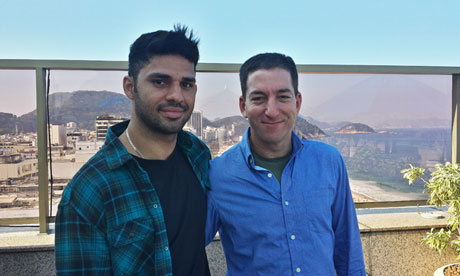
Glenn Greenwald (right) and his partner David Miranda, who was held by UK authorities at Heathrow airport. Photograph: Janine Gibson
The partner of the Guardian journalist who has written a series of stories revealing mass surveillance programmes by the US National SecurityAgency was held for almost nine hours on Sunday by UK authorities as he passed through London's Heathrow airport on his way home to Rio de Janeiro.
David Miranda, who lives with Glenn Greenwald, was returning from a trip to Berlin when he was stopped by officers at 8.05am and informed that he was to be questioned under schedule 7 of the Terrorism Act 2000. The controversial law, which applies only at airports, ports and border areas, allows officers to stop, search, question and detain individuals.
The 28-year-old was held for nine hours, the maximum the law allows before officers must release or formally arrest the individual. Accordingto official figures, most examinations under schedule 7 – over 97% – last less than an hour, and only one in 2,000 people detained are kept for more than six hours.
Miranda was released, but officials confiscated electronics equipment including his mobile phone, laptop, camera, memory sticks, DVDs and games consoles.
Since 5 June, Greenwald has written a series of stories revealing theNSA's electronic surveillance programmes, detailed in thousands of files passed to him by whistleblower Edward Snowden. The Guardian has also published a number of stories about blanket electronic surveillance by Britain's GCHQ, also based on documents from Snowden.
While in Berlin, Miranda had visited Laura Poitras, the US film-maker who has also been working on the Snowden files with Greenwald and the Guardian. The Guardian paid for Miranda's flights.
"This is a profound attack on press freedoms and the news gathering process," Greenwald said. "To detain my partner for a full nine hours while denying him a lawyer, and then seize large amounts of his possessions, is clearly intended to send a message of intimidation to those of us who have been reporting on the NSA and GCHQ. The actions of the UK pose a serious threat to journalists everywhere.
"But the last thing it will do is intimidate or deter us in any way from doing our job as journalists. Quite the contrary: it will only embolden us more to continue to report aggressively."
A spokesperson for the Guardian said: "We were dismayed that the partner of a Guardian journalist who has been writing about the security services was detained for nearly nine hours while passing through Heathrow airport. We are urgently seeking clarification from the British authorities."
A spokesperson for Scotland Yard said: "At 08:05 on Sunday, 18 August a 28-year-old man was detained at Heathrow airport under schedule 7 of the Terrorism Act 2000. He was not arrested. He was subsequently released at 17:00."
Scotland Yard refused to be drawn on why Miranda was stopped using powers that enable police officers to stop and question travellers at UK ports and airports.
There was no comment from the Home Office in relation to the detention. However, there was surprise in political circles and elsewhere. Labour MP Tom Watson said he was shocked at the news and called for it to be made clear if any ministers were involved in authorising the detention.
He said: "It's almost impossible, even without full knowledge of the case, to conclude that Glenn Greenwald's partner was a terrorist suspect.
"I think that we need to know if any ministers knew about this decision, and exactly who authorised it."
"The clause in this act is not meant to be used as a catch-all that can be used in this way."
Schedule 7 of the Terrorism Act has been widely criticised for giving police broad powers under the guise of anti-terror legislation to stop and search individuals without prior authorisation or reasonable suspicion – setting it apart from other police powers.
Those stopped have no automatic right to legal advice and it is a criminal offence to refuse to co-operate with questioning under schedule 7, which critics say is a curtailment of the right to silence.
Last month the UK government said it would reduce the maximum period of detention to six hours and promised a review of the operation on schedule 7 amid concerns it unfairly targets minority groups and gives individuals fewer legal protections than they would have if detained at a police station.
The government of Brazil issued a statement in which it expressed its "grave concern" over the detention of one of its citizens and the use of anti-terror legislation. It said: "This measure is without justification since it involves an individual against whom there are no charges that can legitimate the use of that legislation. The Brazilian government expects that incidents such as the one that happened to the Brazilian citizen today are not repeated."
Widney Brown, Amnesty International's senior director of international law and policy, said: "It is utterly improbable that David Michael Miranda, a Brazilian national transiting through London, was detained at random, given the role his partner has played in revealing the truth about the unlawful nature of NSA surveillance.
"David's detention was unlawful and inexcusable. He was detained under a law that violates any principle of fairness and his detention shows how the law can be abused for petty, vindictive reasons.
"There is simply no basis for believing that David Michael Miranda presents any threat whatsoever to the UK government. The only possible intent behind this detention was to harass him and his partner, Guardian journalist Glenn Greenwald, for his role in analysing the data released by Edward Snowden."
**************************************************************
Britain faces furore over Snowden-linked detention
British authorities faced increasing pressure Monday to explain why they used anti-terror laws to detain the partner of a journalist who worked with US intelligence leaker Edward Snowden.

David Miranda -- the Brazilian partner of Glenn Greenwald, an American journalist with Britain's Guardian newspaper -- was held for almost nine hours on Sunday as he passed through London's Heathrow Airport on his way to Rio de Janeiro from Berlin.
A furious Greenwald said British authorities had "zero suspicion" that Miranda was involved in terrorism and instead spent hours questioning him about the Guardian's reporting on the activities of the US National Security Agency, which has enraged Washington.
"This was obviously designed to send a message of intimidation to those of us working journalistically on reporting on the NSA and its British counterpart, the GCHQ (Government Communications Headquarters)," Greenwald wrote in the Guardian.
"They completely abused their own terrorism law for reasons having nothing whatsoever to do with terrorism."
Miranda, 28, often assists Greenwald with his work, the Guardian said.
He is not an employee of the newspaper but it had paid for his flights. He had stayed in Berlin with Laura Poitras, a US film-maker who has been working with the Guardian.
Miranda said he had been questioned by six agents at Heathrow who confiscated his electronic equipment.
"They asked questions about my entire life, about everything," he said in comments published by the Guardian. "They took my computer, video game, mobile phone, my memory card."
A spokesman for Prime Minister David Cameron said the British government takes "all necessary steps to protect the public from individuals who pose a threat to national security".
"But it is for the police to decide when it is necessary and proportionate to use these powers," the spokesman said.
But authorities were under increasing pressure to explain why he had been held, with Brazil expressing "grave concern" that one of its citizens had been apparently "held incommunicado".
Britain's opposition Labour party called for an urgent investigation into whether anti-terror laws had been misused.
"Any suggestion that terror powers are being misused must be investigated and clarified urgently," said Yvette Cooper, Labour's home affairs spokeswoman.
Britain's independent reviewer of terror legislation, the barrister David Anderson, said he had asked for a briefing on what he described as an "unusual" case.
London's Metropolitan Police confirmed that a 28-year-old man was detained at Heathrow Airport under anti-terrorism legislation.
"He was not arrested. He was subsequently released," a spokesman said.
Brazil's foreign ministry said its embassy in London had contacted British officials prior to Miranda's release and that Brazil would also be seeking an explanation.
"This measure is without justification since it involves an individual against whom there are no charges that can justify the use of that legislation," the ministry said in a statement.
-- 'Revenge tactics' --
Greenwald, a well-known journalist in the United States, analysed and published information on documents released by former US security contractor Snowden revealing huge electronic surveillance operations by the NSA.
Snowden has been granted asylum in Russia after spending five weeks in limbo at a Moscow airport attempting to avoid extradition to the US. He is wanted by Washington on espionage charges.
The Guardian said it was "dismayed" by Miranda's detention and was seeking "clarification" from the British authorities.
Arriving to meet Miranda at Rio's airport, meanwhile, Greenwald said he was now even more determined to continue reporting on the intelligence leaks -- with a new focus on Britain.
"I have many more documents to report on, including ones about the UK, where I'll now focus more," he told reporters.
"I will be more aggressive, not less, in reporting."
British authorities would "come to regret" detaining Miranda, he warned.
Rights group Amnesty International said Miranda was "clearly a victim of unwarranted revenge tactics", while Reporters Without Borders said it was "outraged" by his detention.
"The world's most repressive states often identify journalism with terrorism and now the British authorities have crossed a red line by resorting to this practice," the group said.
************************************************************************************
British authorities faced a furore Monday after they held the partner of a journalist who worked with Edward Snowden to expose US mass surveillance programmes for almost nine hours under anti-terror laws.
David Miranda -- the Brazilian partner of Glenn Greenwald, an American journalist with Britain's Guardian newspaper -- was held on Sunday as he passed through London's Heathrow Airport on his way home to Rio de Janeiro from Berlin.
A furious Greenwald said British authorities had "zero suspicion" that Miranda was involved in terrorism and instead spent hours interrogating him about the Guardian's reporting on the activities of the US National Security Agency, which has enraged Washington.
"This was obviously designed to send a message of intimidation to those of us working journalistically on reporting on the NSA and its British counterpart, the GCHQ," Greenwald wrote in the Guardian.
"They completely abused their own terrorism law for reasons having nothing whatsoever to do with terrorism."
Miranda, 28, had been refused access to a lawyer and officials had taken his laptop and mobile phone, Greenwald added.
The British interior ministry did not immediately comment on Miranda's detention, saying it was a police matter.
But authorities were under increasing pressure to explain why he had been held, with Brazil expressing "grave concern" that one of its citizens had been apparently "held incommunicado" at the airport.
Keith Vaz, chairman of the British parliament's home affairs committee, said he was writing to the police to demand an explanation, describing Miranda's detention as "extraordinary".
"They may have a perfectly reasonable explanation," he told BBC radio.
"But... if we are going to use the (Terrorism) Act in this way, for those issues that are not related to terrorism, then at least we need to know."
London's Metropolitan Police confirmed that a 28-year-old man was detained at Heathrow Airport under anti-terrorism legislation.
"He was not arrested. He was subsequently released," a police spokesman said.
Brazil's foreign ministry said its embassy in London had contacted British officials prior to Miranda's release and that Brazil would also be seeking an explanation from US officials.
"This measure is without justification since it involves an individual against whom there are no charges that can justify the use of that legislation," the ministry said in a statement.
Brazil expects there to be no repeat of the incident, it warned.
Greenwald, a well-known journalist in the US, analysed and published information on documents released by former US security contractor Snowden revealing huge electronic surveillance operations by the NSA.
Snowden has been granted asylum in Russia after spending five weeks in limbo at a Moscow airport attempting to avoid extradition to the US. He is wanted by Washington on espionage charges.
The Guardian said it was "dismayed" by Miranda's detention.
"We are urgently seeking clarification from the British authorities," a spokeswoman said.
Greenwald said Miranda had stayed in Berlin with Laura Poitras, a US filmmaker who worked on the NSA stories. He was on his way to the couple's home in Rio de Janeiro when he was detained.
Greenwald said he had received an early morning phone call regarding Miranda from someone identifying himself as a security official at Heathrow.
"The security official told me that they had the right to detain him for up to nine hours in order to question him, at which point they could either arrest and charge him or ask a court to extend the question time," he wrote.
"The official -- who refused to give his name but would only identify himself by his number: 203654 -- said David was not allowed to have a lawyer present, nor would they allow me to talk to him."
Amnesty International said Miranda was "clearly a victim of unwarranted revenge tactics".
"David's detention was unlawful and inexcusable. He was detained under a law that violates any principle of fairness and his detention shows how the law can be abused for petty vindictive reasons," said the rights group's Widney Brown.
Miranda's detention sparked a furore on Twitter, with several prominent British voices weighing in.
"Holy CRAP -- what is our government up to?" the actor and campaigner Stephen Fry wrote on the website.


.jpg)

