Showing posts with label uk. Show all posts

Monday, August 19, 2013

British Government Proves Snowden correct over surveillance operations by the NSA.

British Government Proves Snowden correct over surveillance operations by the NSA.


"Holy CRAP -- what is our government up to?" the actor and campaigner Stephen Fry wrote on the website.

What is it with stupid governments, stopping someone who is not even in your country but only taking a connecting flight and you hold him for 9 hours !

No if you are in transit you are not really in the country which was why the US was so pissed off when Snowden hid in the Russian Airport. 

Terrorist laws er? because his partner is a reporter and reported on the Snowden case.

So what Snowden is saying must be true then...... well you would not get so worried to hold someone for 9 hours then let them go after downloading all his camera and computer files.    


Glenn Greenwald's partner detained at Heathrow airport for nine hours

David Miranda, partner of Guardian interviewer of whistleblower Edward Snowden, questioned under Terrorism Act

Glenn Greenwald: a failed attempt at intimidation
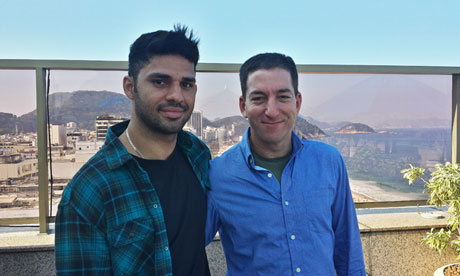
Glenn Greenwald and his partner David Miranda
Glenn Greenwald (right) and his partner David Miranda, who was held by UK authorities at Heathrow airport. Photograph: Janine Gibson
The partner of the Guardian journalist who has written a series of stories revealing mass surveillance programmes by the US National SecurityAgency was held for almost nine hours on Sunday by UK authorities as he passed through London's Heathrow airport on his way home to Rio de Janeiro.
David Miranda, who lives with Glenn Greenwald, was returning from a trip to Berlin when he was stopped by officers at 8.05am and informed that he was to be questioned under schedule 7 of the Terrorism Act 2000. The controversial law, which applies only at airports, ports and border areas, allows officers to stop, search, question and detain individuals.
The 28-year-old was held for nine hours, the maximum the law allows before officers must release or formally arrest the individual. Accordingto official figures, most examinations under schedule 7 – over 97% – last less than an hour, and only one in 2,000 people detained are kept for more than six hours.
Miranda was released, but officials confiscated electronics equipment including his mobile phone, laptop, camera, memory sticks, DVDs and games consoles.
Since 5 June, Greenwald has written a series of stories revealing theNSA's electronic surveillance programmes, detailed in thousands of files passed to him by whistleblower Edward Snowden. The Guardian has also published a number of stories about blanket electronic surveillance by Britain's GCHQ, also based on documents from Snowden.
While in Berlin, Miranda had visited Laura Poitras, the US film-maker who has also been working on the Snowden files with Greenwald and the Guardian. The Guardian paid for Miranda's flights.
"This is a profound attack on press freedoms and the news gathering process," Greenwald said. "To detain my partner for a full nine hours while denying him a lawyer, and then seize large amounts of his possessions, is clearly intended to send a message of intimidation to those of us who have been reporting on the NSA and GCHQ. The actions of the UK pose a serious threat to journalists everywhere.
"But the last thing it will do is intimidate or deter us in any way from doing our job as journalists. Quite the contrary: it will only embolden us more to continue to report aggressively."
A spokesperson for the Guardian said: "We were dismayed that the partner of a Guardian journalist who has been writing about the security services was detained for nearly nine hours while passing through Heathrow airport. We are urgently seeking clarification from the British authorities."
A spokesperson for Scotland Yard said: "At 08:05 on Sunday, 18 August a 28-year-old man was detained at Heathrow airport under schedule 7 of the Terrorism Act 2000. He was not arrested. He was subsequently released at 17:00."
Scotland Yard refused to be drawn on why Miranda was stopped using powers that enable police officers to stop and question travellers at UK ports and airports.
There was no comment from the Home Office in relation to the detention. However, there was surprise in political circles and elsewhere. Labour MP Tom Watson said he was shocked at the news and called for it to be made clear if any ministers were involved in authorising the detention.
He said: "It's almost impossible, even without full knowledge of the case, to conclude that Glenn Greenwald's partner was a terrorist suspect.
"I think that we need to know if any ministers knew about this decision, and exactly who authorised it."
"The clause in this act is not meant to be used as a catch-all that can be used in this way."
Schedule 7 of the Terrorism Act has been widely criticised for giving police broad powers under the guise of anti-terror legislation to stop and search individuals without prior authorisation or reasonable suspicion – setting it apart from other police powers.
Those stopped have no automatic right to legal advice and it is a criminal offence to refuse to co-operate with questioning under schedule 7, which critics say is a curtailment of the right to silence.
Last month the UK government said it would reduce the maximum period of detention to six hours and promised a review of the operation on schedule 7 amid concerns it unfairly targets minority groups and gives individuals fewer legal protections than they would have if detained at a police station.
The government of Brazil issued a statement in which it expressed its "grave concern" over the detention of one of its citizens and the use of anti-terror legislation. It said: "This measure is without justification since it involves an individual against whom there are no charges that can legitimate the use of that legislation. The Brazilian government expects that incidents such as the one that happened to the Brazilian citizen today are not repeated."
Widney Brown, Amnesty International's senior director of international law and policy, said: "It is utterly improbable that David Michael Miranda, a Brazilian national transiting through London, was detained at random, given the role his partner has played in revealing the truth about the unlawful nature of NSA surveillance.
"David's detention was unlawful and inexcusable. He was detained under a law that violates any principle of fairness and his detention shows how the law can be abused for petty, vindictive reasons.
"There is simply no basis for believing that David Michael Miranda presents any threat whatsoever to the UK government. The only possible intent behind this detention was to harass him and his partner, Guardian journalist Glenn Greenwald, for his role in analysing the data released by Edward Snowden."
**************************************************************

Britain faces furore over Snowden-linked detention

British authorities faced increasing pressure Monday to explain why they used anti-terror laws to detain the partner of a journalist who worked with US intelligence leaker Edward Snowden.
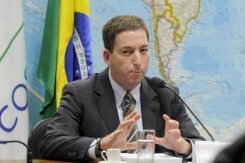
This photo, released by the Brazilian Senate, shows Brazil-based Guardian reporter Glenn Greenwald, pictured in Brasilia, on August 6, 2013. British authorities faced a furore after they held the partner of a journalist who worked with Edward Snowden to expose US mass surveillance programmes for almost nine hours under anti-terror laws.
David Miranda -- the Brazilian partner of Glenn Greenwald, an American journalist with Britain's Guardian newspaper -- was held for almost nine hours on Sunday as he passed through London's Heathrow Airport on his way to Rio de Janeiro from Berlin.
A furious Greenwald said British authorities had "zero suspicion" that Miranda was involved in terrorism and instead spent hours questioning him about the Guardian's reporting on the activities of the US National Security Agency, which has enraged Washington.
"This was obviously designed to send a message of intimidation to those of us working journalistically on reporting on the NSA and its British counterpart, the GCHQ (Government Communications Headquarters)," Greenwald wrote in the Guardian.
"They completely abused their own terrorism law for reasons having nothing whatsoever to do with terrorism."
Miranda, 28, often assists Greenwald with his work, the Guardian said.
He is not an employee of the newspaper but it had paid for his flights. He had stayed in Berlin with Laura Poitras, a US film-maker who has been working with the Guardian.
Miranda said he had been questioned by six agents at Heathrow who confiscated his electronic equipment.
"They asked questions about my entire life, about everything," he said in comments published by the Guardian. "They took my computer, video game, mobile phone, my memory card."
A spokesman for Prime Minister David Cameron said the British government takes "all necessary steps to protect the public from individuals who pose a threat to national security".
"But it is for the police to decide when it is necessary and proportionate to use these powers," the spokesman said.
But authorities were under increasing pressure to explain why he had been held, with Brazil expressing "grave concern" that one of its citizens had been apparently "held incommunicado".
Britain's opposition Labour party called for an urgent investigation into whether anti-terror laws had been misused.
"Any suggestion that terror powers are being misused must be investigated and clarified urgently," said Yvette Cooper, Labour's home affairs spokeswoman.
Britain's independent reviewer of terror legislation, the barrister David Anderson, said he had asked for a briefing on what he described as an "unusual" case.
London's Metropolitan Police confirmed that a 28-year-old man was detained at Heathrow Airport under anti-terrorism legislation.
"He was not arrested. He was subsequently released," a spokesman said.
Brazil's foreign ministry said its embassy in London had contacted British officials prior to Miranda's release and that Brazil would also be seeking an explanation.
"This measure is without justification since it involves an individual against whom there are no charges that can justify the use of that legislation," the ministry said in a statement.
-- 'Revenge tactics' --
Greenwald, a well-known journalist in the United States, analysed and published information on documents released by former US security contractor Snowden revealing huge electronic surveillance operations by the NSA.
Snowden has been granted asylum in Russia after spending five weeks in limbo at a Moscow airport attempting to avoid extradition to the US. He is wanted by Washington on espionage charges.
The Guardian said it was "dismayed" by Miranda's detention and was seeking "clarification" from the British authorities.
Arriving to meet Miranda at Rio's airport, meanwhile, Greenwald said he was now even more determined to continue reporting on the intelligence leaks -- with a new focus on Britain.
"I have many more documents to report on, including ones about the UK, where I'll now focus more," he told reporters.
"I will be more aggressive, not less, in reporting."
British authorities would "come to regret" detaining Miranda, he warned.
Rights group Amnesty International said Miranda was "clearly a victim of unwarranted revenge tactics", while Reporters Without Borders said it was "outraged" by his detention.
"The world's most repressive states often identify journalism with terrorism and now the British authorities have crossed a red line by resorting to this practice," the group said.


************************************************************************************
British authorities faced a furore Monday after they held the partner of a journalist who worked with Edward Snowden to expose US mass surveillance programmes for almost nine hours under anti-terror laws.
David Miranda -- the Brazilian partner of Glenn Greenwald, an American journalist with Britain's Guardian newspaper -- was held on Sunday as he passed through London's Heathrow Airport on his way home to Rio de Janeiro from Berlin.
A furious Greenwald said British authorities had "zero suspicion" that Miranda was involved in terrorism and instead spent hours interrogating him about the Guardian's reporting on the activities of the US National Security Agency, which has enraged Washington.
"This was obviously designed to send a message of intimidation to those of us working journalistically on reporting on the NSA and its British counterpart, the GCHQ," Greenwald wrote in the Guardian.
"They completely abused their own terrorism law for reasons having nothing whatsoever to do with terrorism."
Miranda, 28, had been refused access to a lawyer and officials had taken his laptop and mobile phone, Greenwald added.
The British interior ministry did not immediately comment on Miranda's detention, saying it was a police matter.
But authorities were under increasing pressure to explain why he had been held, with Brazil expressing "grave concern" that one of its citizens had been apparently "held incommunicado" at the airport.
Keith Vaz, chairman of the British parliament's home affairs committee, said he was writing to the police to demand an explanation, describing Miranda's detention as "extraordinary".
"They may have a perfectly reasonable explanation," he told BBC radio.
"But... if we are going to use the (Terrorism) Act in this way, for those issues that are not related to terrorism, then at least we need to know."
London's Metropolitan Police confirmed that a 28-year-old man was detained at Heathrow Airport under anti-terrorism legislation.
"He was not arrested. He was subsequently released," a police spokesman said.
Brazil's foreign ministry said its embassy in London had contacted British officials prior to Miranda's release and that Brazil would also be seeking an explanation from US officials.
"This measure is without justification since it involves an individual against whom there are no charges that can justify the use of that legislation," the ministry said in a statement.
Brazil expects there to be no repeat of the incident, it warned.
Greenwald, a well-known journalist in the US, analysed and published information on documents released by former US security contractor Snowden revealing huge electronic surveillance operations by the NSA.
Snowden has been granted asylum in Russia after spending five weeks in limbo at a Moscow airport attempting to avoid extradition to the US. He is wanted by Washington on espionage charges.
The Guardian said it was "dismayed" by Miranda's detention.
"We are urgently seeking clarification from the British authorities," a spokeswoman said.
Greenwald said Miranda had stayed in Berlin with Laura Poitras, a US filmmaker who worked on the NSA stories. He was on his way to the couple's home in Rio de Janeiro when he was detained.
Greenwald said he had received an early morning phone call regarding Miranda from someone identifying himself as a security official at Heathrow.
"The security official told me that they had the right to detain him for up to nine hours in order to question him, at which point they could either arrest and charge him or ask a court to extend the question time," he wrote.
"The official -- who refused to give his name but would only identify himself by his number: 203654 -- said David was not allowed to have a lawyer present, nor would they allow me to talk to him."
Amnesty International said Miranda was "clearly a victim of unwarranted revenge tactics".
"David's detention was unlawful and inexcusable. He was detained under a law that violates any principle of fairness and his detention shows how the law can be abused for petty vindictive reasons," said the rights group's Widney Brown.
Miranda's detention sparked a furore on Twitter, with several prominent British voices weighing in.
"Holy CRAP -- what is our government up to?" the actor and campaigner Stephen Fry wrote on the website.

Thursday, April 4, 2013

The Great British class calculator


Take the test just click here: 

http://www.bbc.co.uk/news/magazine-22000973


People in the UK now fit into seven social classes, a major survey conducted by the BBC suggests.
It says the traditional categories of working, middle and upper class are outdated, fitting 39% of people.
It found a new model of seven social classes ranging from the elite at the top to a "precariat" - the poor, precarious proletariat - at the bottom.
More than 161,000 people took part in the Great British Class Survey, the largest study of class in the UK.
Class has traditionally been defined by occupation, wealth and education. But this research argues that this is too simplistic, suggesting that class has three dimensions - economic, social and cultural.
The BBC Lab UK study measured economic capital - income, savings, house value - and social capital - the number and status of people someone knows.
The study also measured cultural capital, defined as the extent and nature of cultural interests and activities.
The new classes are defined as:
  • Elite - the most privileged group in the UK, distinct from the other six classes through its wealth. This group has the highest levels of all three capitals
  • Established middle class - the second wealthiest, scoring highly on all three capitals. The largest and most gregarious group, scoring second highest for cultural capital
  • Technical middle class - a small, distinctive new class group which is prosperous but scores low for social and cultural capital. Distinguished by its social isolation and cultural apathy
  • New affluent workers - a young class group which is socially and culturally active, with middling levels of economic capital
  • Traditional working class - scores low on all forms of capital, but is not completely deprived. Its members have reasonably high house values, explained by this group having the oldest average age at 66
  • Emergent service workers - a new, young, urban group which is relatively poor but has high social and cultural capital
  • Precariat, or precarious proletariat - the poorest, most deprived class, scoring low for social and cultural capital
The researchers said while the elite group had been identified before, this is the first time it had been placed within a wider analysis of the class structure, as it was normally put together with professionals and managers.
At the opposite extreme they said the precariat, the poorest and most deprived grouping, made up 15% of the population.
The sociologists said these two groups at the extremes of the class system had been missed in conventional approaches to class analysis, which have focused on the middle and working classes.
Methodology
Professor of sociology at Manchester University, Fiona Devine, said the survey really gave a sense of class in 21st Century Britain.

Start Quote

The survey has really allowed us to drill down and get a much more complete picture of class in modern Britain”
Prof Fiona DevineManchester University
"What it allows us is to understand is a more sophisticated, nuanced picture of what class is like now.
"It shows us there is still a top and a bottom, at the top we still have an elite of very wealthy people and at the bottom the poor, with very little social and cultural engagement," she said.
"It's what's in the middle which is really interesting and exciting, there's a much more fuzzy area between the traditional working class and traditional middle class.
"There's the emergent workers and the new affluent workers who are different groups of people who won't necessarily see themselves as working or middle class.
"The survey has really allowed us to drill down and get a much more complete picture of class in modern Britain."
Solicitor Vikki Harding is classed as an 'emergent service worker' under the new ranking
The researchers also found the established middle class made up 25% of the population and was the largest of all the class groups, with the traditional working class now only making up 14% of the population.
They say the new affluent workers and emergent service workers appear to be the children of the "traditional working class," which they say has been fragmented by de-industrialisation, mass unemployment, immigration and the restructuring of urban space.

What class are you?

Class figures
  • The full class survey takes about 25 minutes and covers wealth and job type, interests and social circle
  • Compare your score to the nation's
  • Receive a personalised coat-of-arms
BBC Lab UK worked with Prof Mike Savage of the London School of Economics and Prof Devine on the study.
The findings have been published in the Sociology Journal and presented at a conference of the British Sociological Association on Wednesday.
Researchers asked a series of questions about income, house value, savings, cultural and leisure activities and the occupations of friends.
They were able to determine a person's economic, social and cultural capital scores from the answers and analysed the scores to create its class system.
The GBCS was launched online in January 2011, but data showed participants were predominantly drawn from the well-educated social groups.
To overcome this a second identical survey was run with a survey company GFK, with a sample of people representing the population of the UK as a whole, using the information in parallel.
Which of the seven new class categories do you fit in? Or do you have your own way of describing your class? Please send us your comments using the form below.

Professor Mike Savage from the London School of Economics and Professor Fiona Devine from the University of Manchester Mike Savage and Fiona Devine examined class in a brand new way

Related Stories

Mike Savage from the London School of Economics and Fiona Devine from the University of Manchester describe their findings from The Great British Class Survey. Their results identify a new model of class with seven classes ranging from the Elite at the top to a 'Precariat' at the bottom.
In January 2011, with the help of BBC Lab UK, we asked the BBC audience to complete a unique questionnaire on different dimensions of class.

Start Quote

We now have a much more complex class system”
We devised a new way of measuring class, which doesn't define class just by the job that you do, but by the different kinds of economic, cultural and social resources or 'capitals' that people possess.
We asked people about their income, the value of their home and savings, which together is known as 'economic capital', their cultural interests and activities, known as 'cultural capital' and the number and status of people they know, which is called 'social capital'.
Amazingly, more than 160,000 of you completed the survey. We now have one of the largest ever studies of class in Great Britain.

The results to date

Our new model includes seven classes.

What class are you?

Class figures
  • The full class survey takes about 25 minutes and covers wealth and job type, interests and social circle
  • Compare your score to the nation's
  • Receive a personalised coat-of-arms
  • Elite: This is the most privileged class in Great Britain who have high levels of all three capitals. Their high amount of economic capital sets them apart from everyone else.
  • Established Middle Class: Members of this class have high levels of all three capitals although not as high as the Elite. They are a gregarious and culturally engaged class.
  • Technical Middle Class: This is a new, small class with high economic capital but seem less culturally engaged. They have relatively few social contacts and so are less socially engaged.
  • New Affluent Workers: This class has medium levels of economic capital and higher levels of cultural and social capital. They are a young and active group.
  • Emergent Service Workers: This new class has low economic capital but has high levels of 'emerging' cultural capital and high social capital. This group are young and often found in urban areas.
  • Traditional Working Class: This class scores low on all forms of the three capitals although they are not the poorest group. The average age of this class is older than the others.
  • Precariat: This is the most deprived class of all with low levels of economic, cultural and social capital. The everyday lives of members of this class are precarious.

Other unique findings

  • Twentieth-century middle-class and working-class stereotypes are out of date. Only 39% of participants fit into the Established Middle Class and Traditional Working Class categories.

Start Quote

The very rich and very poor are still with us in the 21st Century”
  • The traditional working class is changing. It's smaller than it was in the past. The new generation are more likely to be Affluent Workers or Emergent Service Workers.
  • People consume culture in a complicated way. The Technical Middle Class are less culturally engaged while emergent service workers participate in various activities.
  • The extremes of our class system are very important. The Elite and Precariat often get forgotten with more focus on the middle and working classes. We've discovered detailed findings about them.

What did we measure?

People tend to think they belong to a particular class on the basis of their job and income. These are aspects of economic capital. Sociologists think that your class is indicated by your cultural capital and social capital. Our analysis looked at the relationship between economic, cultural and social capital.
The findings have been published in the journal Sociology and were presented at a conference of the British Sociological Association.

Who took part?

Crowd in UK celebrating the Olympics. File pic: 2012
A total of 161,458 people from around the UK completed the survey. The majority (86%) lived in England while 8% lived in Scotland, 3% in Wales and 1% in Northern Ireland.
Of that total, 91,458 men (56%) and 69,902 women (43%) completed the survey. They had an average age of 35 and 145,521 participants (90%) described themselves as 'white'.
This very large sample allowed us to analyse the connections between the different capitals using a technique called 'latent class analysis'.
This produced a lot of very detailed information which took a long time to examine. There's still plenty of exciting work still to be done!
The data from the Great British Class Survey was analysed by a team including Niall Cunningham, Yaojun Li and Andrew Miles from the University of Manchester, Mark Taylor from the University of York, Sam Friedman from City University, Johs Hjellbrekke from the University of Bergen, Norway and Brigette Le Roux of Universite Paris Descartes, France.

More on This Story

Related Stories

The Great British Class Survey is the biggest scientific investigation into social class in the UK

Related Stories

Sociologists are interested in the idea that class is about your cultural tastes and activities as well as the type and number of people you know.
These factors are important when put alongside people's economic position.
Professors Mike Savage and Fiona Devine explain how a BBC Lab UK experiment allowed them to better understand class in the 21st Century.

Measuring Class

Pierre BourdieuPierre Bourdieu investigated what propelled people into the upper strata
Understanding classes as amounts of different types of 'capitals' helps us to see class across a number of dimensions.
The French sociologist, Pierre Bourdieu first developed this approach in 1984, suggesting there are different types of capitals which give people an advantage in life. Economic, cultural and social capital may overlap but they are different. Using this approach, we distinguished between people with different amounts of each of these three capitals.
It's been difficult to test this approach in Britain because comprehensive questions on cultural and social capital are rarely asked in national surveys. Sociologists need large amounts of data to unravel the complicated way the different capitals interact with each other, in many different people.
So we were excited to test this approach for the first time by designing a survey with BBC Lab UK.

The Great British Class Survey

We wanted to find detailed ways of measuring how much economic, cultural and social capital people possess.

What class are you?

Class figures
  • The original class survey takes about 25 minutes and covers wealth and job type, interests and social circle
  • Compare your score to the nation's
  • Receive a personalised coat-of-arms
The questions we asked about people's leisure interests, musical tastes, use of the media and food preferences helped us build a picture of Britain's cultural consumption.
To investigate social capital, we used a 'position generator' developed by the American sociologist Nan Lin in 2001 to measure the range of people's social ties. We asked our participants whether they knew anyone in 37 different occupations.
The questions on economic capital asked about household income, whether you owned your own property, how much it was worth, and your savings. This meant we had unusually detailed measures of the different types of economic capital.
We also collected extensive information about people's household composition, education, social mobility and political attitudes. This data allowed us to understand our measures of economic, cultural and social capital in the context of other important aspects of people's lives.

Measuring Your Capitals

Cultural Capital
People enjoying a gigGoing to gigs is an emerging form of cultural activity
It was complicated working out how to measure cultural capital because we needed to understand how some cultural activities tend to cluster together and how some are associated with being advantaged in the first place.
To find out which cultural activities tended to go together, we did some statistics called multiple correspondence analysis on the 27 cultural activities listed in the survey. This analysis was based on the interests participants said they liked or disliked and the activities they told us they did or didn't do.
From this analysis we could determine the people interested in 'highbrow' culture, like going to the theatre or listening to classical music; and those attracted to more 'popular' or 'emerging' forms of culture, like using social media or going to gigs. We found that there were three distinct groups; those who engaged with 'highbrow' culture, those interested in 'emerging' culture and those who were pretty uninterested in culture of any kind.

Start Quote

Classes are bundles of economic, cultural and social capital that convey advantage for individuals and families from one generation to the next”
We decided to use engagement in 'highbrow' and 'emerging' culture as measures of cultural capital. We measured how much 'highbrow' culture people consumed by scoring how engaged they were with classical music, attending stately homes and so on. We measured how much 'emerging' cultural capital people owned by scoring their engagement with video games, a preference for hip-hop and so forth.
Social Capital
The 37 different occupations listed in the online survey for people to identify as friends were taken from the very well established Cambridge Social Interaction and Stratification (CAMSIS) scale. For each participant, we were able to assess how many of the 37 occupations they reported, the average importance of their contacts and their range of people they know.
We decided to focus on two ways of measuring social capital. We measured the average status or importance of people's social contacts and the number of occupations people said they knew.
Economic Capital
We asked people about their household income, household savings and the value of their house. We combined this information to make a 'score' which represented each participant's economic capital.
It's important to emphasise that these measures are for the household and it is possible for some people who aren't in well-paid jobs themselves to achieve high scores because of the income of other members of the household. They might be members of the same family although they might not be related.
The findings have been published in the journal Sociology and were presented at a conference of the British Sociological Association.
Find out more about the results of the Great British Class Survey here.